

A keloid on the earlobe, chest or shoulder is flattened with injections placed directly into the raised scar, repeated every 3 to 6 weeks as it responds. That is how keloid removal in Korea works at Pixelab Beauty Clinic: the goal is a softer, flatter scar, the fee is set per centimeter, and the clinic states openly that keloids can recur.
Is it for you?
Who keloid injections suit, and when to hold off
A keloid is scar tissue that keeps growing after a wound has closed. It rises above the surrounding skin, grows beyond the borders of the first injury onto healthy skin, and can itch, sting or feel tight under clothing. A piercing, an acne spot, a vaccination or a surgical cut can each start one. A thick hypertrophic scar looks alike but stays inside the wound line, and the same injections are used on it when it stays raised.
Because the medicine acts inside the scar, the plan starts by measuring every keloid along its length and noting how firm, itchy or tender it is. The items in the second list are reasons to wait or to have the lump looked at first. Treatment can be planned once they settle or the lump has been checked.
Usually a good fit
- Raised keloid on an earlobe after piercing
- Keloid on the chest, shoulder or upper back
- Thick, raised scar after surgery or acne
- Scar that itches, stings or feels tight
- Able to come back every 3–6 weeks for repeat injections
We may suggest waiting
- Pregnancy or breastfeeding
- Infection, an open wound or a cold sore on the area
- A lump that grows fast, bleeds or is not yet confirmed as a scar
- Already on steroid tablets or other high-dose steroids (tell the clinic)
- Expecting the keloid to disappear without a trace
Your doctor
Founder and medical director · Korean board-certified plastic surgeon
“From learning to teaching.”Trained at Seoul & Incheon St. Mary's Hospitals. Now leading hands-on sessions for visiting doctors.
- ResidentPlastic surgery, Catholic Univ. Seoul St. Mary's Hospital
- FellowClinical fellow, Incheon St. Mary's Hospital
- AlmaTitanium Global Trainer
- JeisysDENSITY ALPHA TIP Ambassador
- MemberKorean Society of Plastic and Reconstructive Surgeons
How it works
How keloid injections work on a raised scar
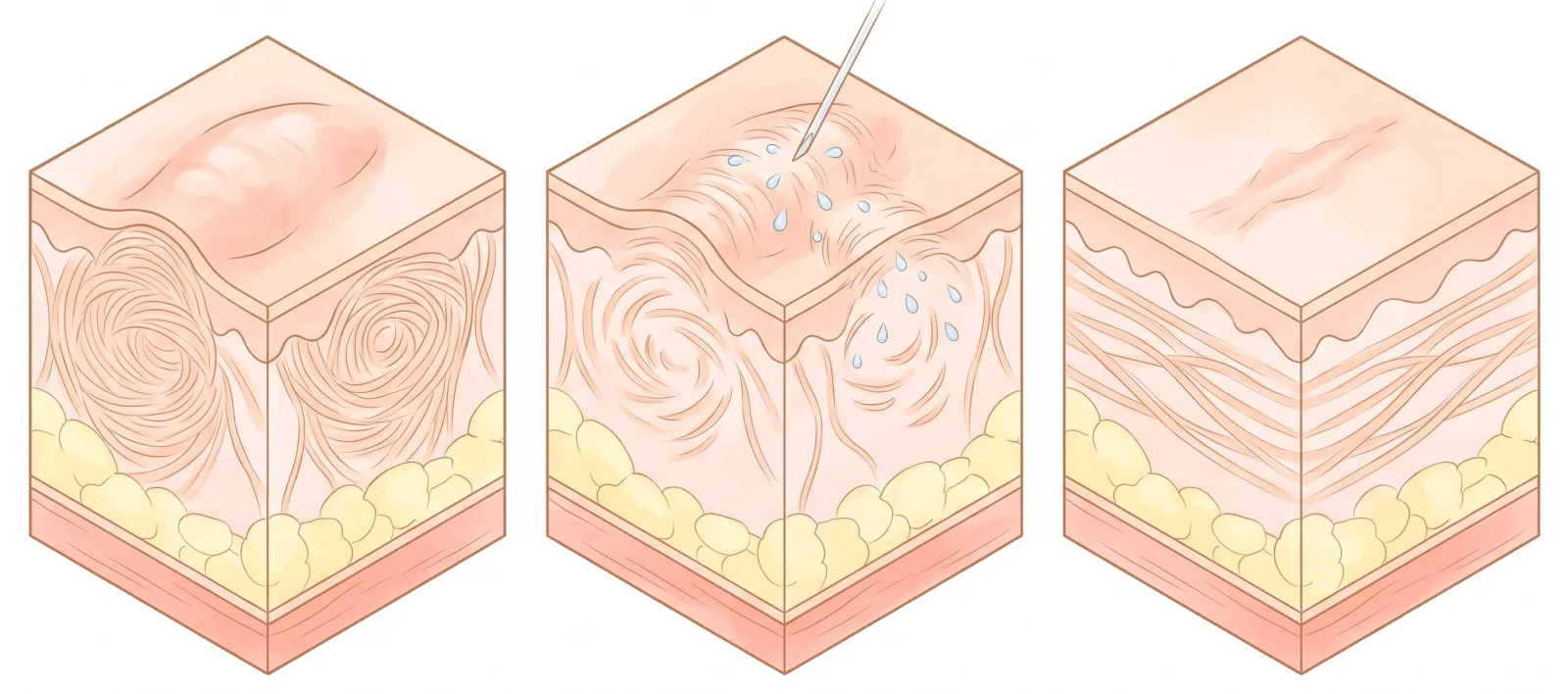
Keloid tissue holds far more collagen than normal skin, packed in thick, tangled bundles, and the fibroblasts that make it stay active long after the wound has healed. An injection treatment places medicine into the body of the scar through a fine needle, so it acts on those cells where they sit.
In published studies the injected medicine is generally a corticosteroid such as triamcinolone acetonide. It calms inflammation and slows collagen production, and the scar softens and sinks toward skin level over repeated rounds. Some studies mix it with 5-fluorouracil (5-FU), and a 2023 meta-analysis found that the mixture improved raised scars more than either drug on its own (Mavilakandy, 2023). Verapamil has also been tested against triamcinolone: triamcinolone softened scars more at three weeks, while verapamil caused fewer side effects (Jiang, 2020). The clinic's price list names the item as a keloid scar injection and does not name the drug, so ask which medicine and dose are planned for your scar.
Each keloid is measured in centimeters, because the fee follows scar length. The needle enters the firm part of the scar, and in general the amount injected is matched to its size and thickness. A wide or very hard keloid can take several rounds before it gives, and keloids in different places on the body can respond at different speeds.
Evidence on keloid treatment as a whole is limited. A 2023 systematic review of 108 studies found most were small and built differently, so no single method can be named the standard with confidence (Walsh, 2023). A Cochrane review of laser treatment for raised scars likewise judged the evidence too weak to draw firm conclusions (Leszczynski, 2022).
Measuring the scar
At consultationEach keloid is measured in centimeters and checked for firmness, itching and tenderness.
Cleaning and numbing
The skin is cleaned, and the injection is given either without numbing or under local anesthesia.
Injection into the scar
A fine needle places the medicine into the firm body of the keloid, spread along its length.
Before you leave
Light pressure stops any bleeding, and a same-day flight home is possible.
Review and repeat
Every 3–6 weeksThe scar is reassessed and the next round is planned by how much it has softened.
Raised-scar options on the clinic's price list
| Criteria | Keloid injection | Scar laser bundle | Surgical scar treatment |
|---|---|---|---|
| What it targets | Raised keloids and thick hypertrophic scars | Sunken scars and uneven texture | Healed cesarean, thyroid or breast surgery scars |
| How it works | Medicine placed inside the scar to soften it | Fractional laser and other devices resurface skin | Scar devices used along the healed incision |
| Numbing | None, or local anesthesia | Numbing cream, around 50 minutes | Cream, local or sedation, by extent |
| After the visit | Soreness, bruising or a small dent | Redness for days, tape for about a week | Redness, scabs, swelling 2 weeks or more |
| Repeat schedule | Every 3–6 weeks as it responds | 3–5 sessions, 2 months or more apart | Repeated to suit the scar |
| How it is priced | ₩20,000 + VAT per cm | By area and session count | Per area, on the scar treatment page |
Raised keloids are mainly injected; the two laser options sit on the same price list and suit flatter or sunken scars. The table is not a ranking.
Session by session
| When | What to expect |
|---|---|
| First visit | Keloids are measured and the first injection is given; a same-day flight home is possible. |
| 3–6 weeks later | Softness and height are checked, and another injection follows if the scar is still raised. |
| Later rounds | Injections continue at 3–6 week gaps while the scar keeps improving; since keloids can recur, later checks still matter. |
At a glance
Keloid injection facts at a glance
| Numbing | No numbing, or local anesthesia |
|---|---|
| Downtime | Possible pain, bruising or a temporary dent at the site |
| Recommended sessions | Repeated every 3–6 weeks, guided by progress |
| How long results last | Varies by person; keloids can recur |
| Earliest flight home | Same-day flight home is possible |
Prices
Keloid Treatment Cost in South Korea
Keloid injections are charged by the length of scar treated, at ₩20,000 + VAT for each centimeter. A small earlobe keloid and a long scar across the chest therefore end up at very different totals. Measuring comes before any needle is used, so the quote is tied to the scar you actually have.
The listed fee leaves out the 10% VAT, and the price card shows the amount with VAT beside it. Rounds repeat every 3 to 6 weeks, so budget by visit and by the number of rounds your scar may need. Ask the clinic to spell out in the quote how the per-centimeter fee applies at repeat visits, and to list each keloid separately if you have several.
Keloid scar injection
Per cm of scar₩20,000 + VAT₩22,000 with VATBook nowRecovery
After a keloid injection
Soreness or a small bruise is possible; same-day flight home is possible
Bruising and tenderness ease; keep the site clean and avoid rubbing it
Return for a check; another injection is planned if the scar is still raised
A thinned, slightly sunken patch can appear; the clinic describes it as temporary
Safety
Keloid injection risks and limits
Injecting medicine into scar tissue has these known risks:
- Pain during the injection and soreness afterward, since keloid tissue is dense.
- Bruising or a small bleed where the needle went in.
- Thinning of the skin or a dent around the scar (atrophy), which the clinic lists as temporary.
- Lighter patches or fine visible blood vessels (telangiectasia) near the site, reported with steroid injections in general.
- Effects beyond the skin: case reports link triamcinolone injected into scars with Cushing's syndrome, with children at greatest risk and adult doses within recommended limits carrying lower risk (Fredman, 2013).
- Regrowth: a keloid that has flattened can grow again, and how long improvement holds differs from person to person.
Tell the clinic about steroid creams, inhalers or tablets you already use, and about diabetes, since steroids can raise blood sugar.
Message the clinic if the site becomes hot, swollen and more painful each day, or if pus appears, because those point to infection.
Evidence
Research behind this page
- Comparing Combination Triamcinolone Acetonide and 5-Fluorouracil with Monotherapy Triamcinolone Acetonide or 5-Fluorouracil in the Treatment of Hypertrophic Scars: A Systematic Review and Meta-AnalysisPlastic & Reconstructive Surgery · 2023 · Mavilakandy A et al. · doi:10.1097/prs.0000000000010867
A meta-analysis in which triamcinolone combined with 5-fluorouracil improved keloid and hypertrophic scars more than either drug injected alone.
- The Safety and Efficacy of Intralesional Verapamil Versus Intralesional Triamcinolone Acetonide for Keloids and Hypertrophic Scars: A Systematic Review and Meta-analysisAdvances in Skin & Wound Care · 2020 · Jiang Z et al. · doi:10.1097/01.asw.0000655476.10403.d6
A meta-analysis comparing injected verapamil with triamcinolone: triamcinolone improved scar softness and redness more at three weeks, while verapamil had fewer side effects.
- Keloid treatments: an evidence-based systematic review of recent advancesSystematic Reviews · 2023 · Walsh L et al. · doi:10.1186/s13643-023-02192-7
A systematic review of 108 keloid treatment studies; small, varied designs limit the conclusions, and large controlled trials are still needed.
- Laser therapy for treating hypertrophic and keloid scarsCochrane Database of Systematic Reviews · 2022 · Leszczynski R et al. · doi:10.1002/14651858.cd011642.pub2
A Cochrane review finding the evidence on lasers for hypertrophic and keloid scars insufficient, with mixed results and few long-term studies on recurrence.
- Cushing's syndrome after intralesional triamcinolone acetonide: A systematic review of the literature and multinational surveyBurns · 2013 · Fredman R · doi:10.1016/j.burns.2012.09.020
A review of case reports of Cushing's syndrome after triamcinolone injected into scars; risk appears low at recommended adult doses, with children most at risk.
FAQ
Keloid treatment questions from overseas visitors
How many keloid injections will I need?
There is no set number. The clinic repeats injections every 3 to 6 weeks and judges each round by how much the scar has softened and flattened. Larger, harder and older keloids can take more rounds, so plan for return trips to Seoul from the start.
What is the downtime after a keloid injection?
Very little time off is needed. The clinic lists pain, bruising and a temporary dent at the injection site as possible effects. Bruising shows more on thin skin such as the earlobe, so leave some room before photos or events if that matters to you.
Can I fly home the same day after keloid injections?
Yes, the clinic allows a same-day flight home. The bigger planning question is the gap between rounds: injections repeat every 3 to 6 weeks, so each trip covers one round. On the plane, keep the site clean and avoid earrings or straps pressing on it.
Do keloids come back after steroid injections?
They can. The clinic states that results differ between people and that keloids may recur, and published reviews describe regrowth as a limit of every keloid treatment studied so far. Keeping new injuries, such as fresh piercings, away from keloid-prone skin lowers the chance of a new one.
Which medicine is used in keloid injections?
The price list calls it a keloid scar injection and does not name the drug. In published studies the medicine is generally a corticosteroid such as triamcinolone, sometimes mixed with 5-FU. Ask which product and dose are planned, and mention any steroids you already take.
Is keloid treatment here overseen by a surgeon?
Yes. Dr. Jongkeun Song is a Korean board-certified plastic surgeon and the Medical Director of Pixelab Beauty Clinic. Plastic surgery training includes wound healing and the care of abnormal scars, the field that keloids belong to.
How much does keloid injection cost, and is VAT included?
It is charged per centimeter of scar at ₩20,000 before VAT, or ₩22,000 once the 10% VAT is added. Your total depends on how many centimeters are treated and how many rounds you need, so ask for each keloid to be itemized.
Does a keloid injection hurt?
It can sting, because the needle has to enter firm scar tissue. The injection is given without numbing or under local anesthesia. Soreness at the site afterward is one of the effects the clinic lists, and it is worth mentioning if earlier injections were hard for you.
Can I talk to the clinic in English before booking?
Yes. An English interpreter is on staff, and you can send questions and photos of your keloid through WhatsApp in English before you plan the trip. We will get back to you as soon as possible.
Is there a deposit to book keloid treatment?
Deposit and cancellation terms are not listed here. Before paying anything, ask for the terms in writing along with your per-centimeter quote, so you know what happens if a flight changes or a follow-up visit has to move.
Can earlobe keloids from piercing be treated with injections?
Yes. An earlobe keloid after piercing is a raised keloid like any other and is priced by the centimeter. Avoid re-piercing the same spot, since a new wound in keloid-prone skin can start the process again.
Will my insurance cover keloid treatment in Korea?
We cannot say whether your insurer will pay for keloid treatment abroad. Ask your provider before you travel, and keep the itemized receipt from the clinic in case you decide to make a claim.