


A hollow forehead or sunken temples can be filled with fat taken from your own body, and that transfer is what facial fat grafting in Korea involves at Pixelab Beauty Clinic. The surgery is done under IV sedation, swelling and bruising take weeks to settle, and the result is reviewed 3 to 6 months later because part of the grafted fat is absorbed.
Is it for you?
Candidates for fat transfer to the face
Faces lose volume in specific places. The temples cave in and make the upper face look narrow, and a forehead that was once rounded can turn flat or uneven. Fat grafting replaces that lost volume with living tissue from your own body, so there is no foreign material left in the face.
Two things decide whether it makes sense. The first is supply: the surgery needs a donor area with fat to spare, and very lean people may not have enough. The second is patience. Fat that survives the move becomes part of the face, yet the final shape only shows once the swelling is gone and the graft has settled over several months.
The reasons to wait in the list below are about safety and about getting a result that lasts. Grafted fat behaves like the rest of your body fat, so a big weight change after surgery changes the treated areas as well.
Usually a good fit
- Hollow or flat forehead
- Sunken temples that narrow the upper face
- Volume loss you prefer to treat with your own tissue
- Enough body fat to spare at a donor area
- Able to wait 3–6 months for the result review
We may suggest waiting
- Very low body fat with little to harvest
- Large weight loss or gain planned soon
- Pregnancy or breastfeeding
- Infection or inflammation on the face or donor area
- Blood thinners or a bleeding disorder (tell the clinic first)
- Expecting a fixed, exact volume to remain

Your doctor
Founder and medical director · Korean board-certified plastic surgeon
“From learning to teaching.”Trained at Seoul & Incheon St. Mary's Hospitals. Now leading hands-on sessions for visiting doctors.
- ResidentPlastic surgery, Catholic Univ. Seoul St. Mary's Hospital
- FellowClinical fellow, Incheon St. Mary's Hospital
- AlmaTitanium Global Trainer
- JeisysDENSITY ALPHA TIP Ambassador
- MemberKorean Society of Plastic and Reconstructive Surgeons
How it works
How fat transfer to the face works
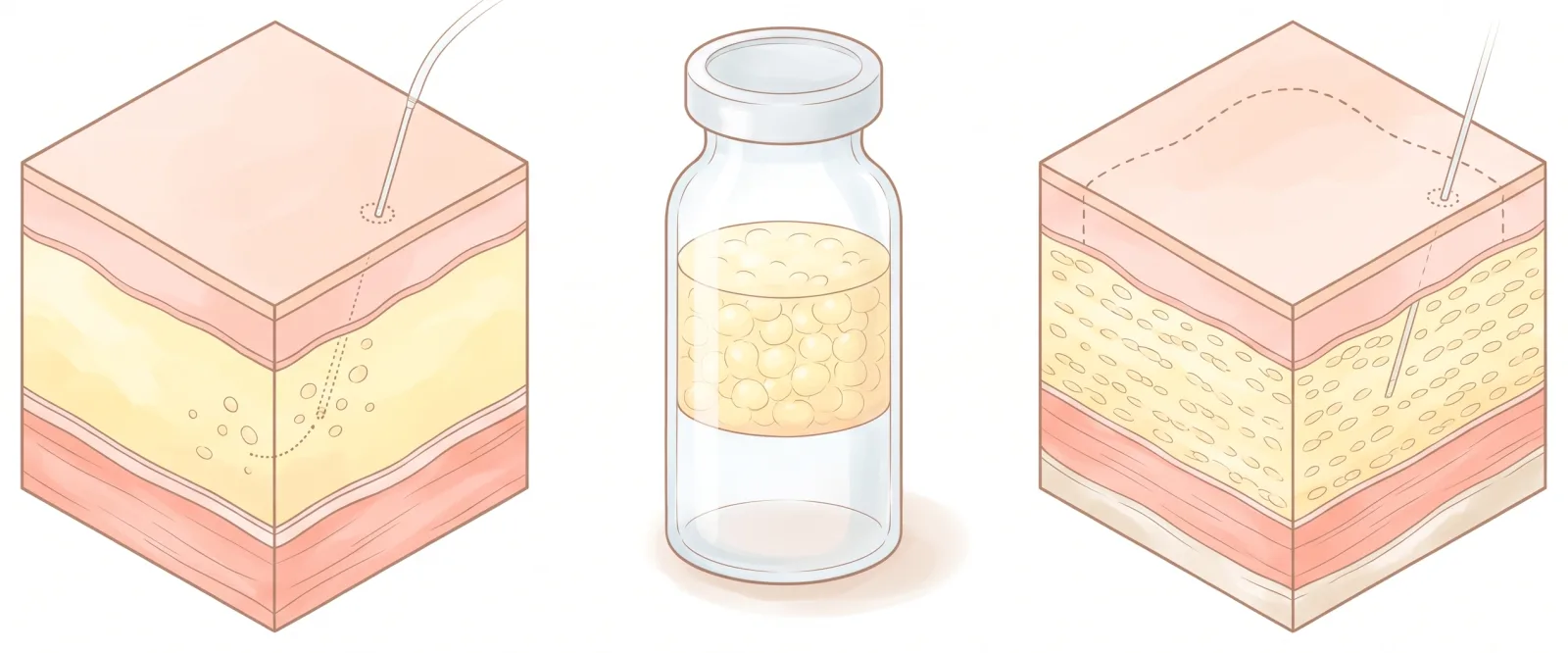
Fat grafting, also called fat transfer or autologous fat grafting, is one surgery in two halves. In the first half, fat is drawn out of a donor area through a thin cannula, the same basic tool used in liposuction. In the second, the prepared fat is injected back in small amounts into the forehead, the temples or other hollow areas of the face.
Grafted fat arrives without a blood supply of its own. It lives only if new vessels grow into it from the tissue around it, so it is laid in as fine threads spread through several layers. A large single deposit is hard for new vessels to reach, and its center can die and harden.
The same biology explains why a share of the fat is absorbed. A 2020 meta-analysis found that facial graft retention could not be predicted reliably, and studies that measured volume objectively reported an average of about 47% remaining (Lv, 2020). The clinic's own treatment sheet says the same thing in plain terms: fat that takes stays long term, and some of it is absorbed.
The price list also carries a Stem Cell Add-on, an optional line named here exactly as the clinic writes it. This page makes no claim about how much it adds to a graft. Published work on a related idea, enriching fat with cells before grafting (cell-assisted lipotransfer), points both ways: one meta-analysis reported better outcomes than plain grafting yet found no proof of fewer complications (Zhou, 2016), and another saw better retention only for small volumes, with more complications and no fall in repeat surgery (Laloze, 2017). A review of additives used in facial grafting concluded that their effect on retention is still unclear (Schipper, 2022). If you are weighing the add-on, ask what it involves and why it would suit your face.
Because this is surgery, Dr. Jongkeun Song, a Korean board-certified plastic surgeon, performs both the harvest and the grafting.
Facial assessment
At consultationHollow areas are marked and the volume each one needs is weighed against the donor fat you have.
IV sedation
Medicine is given through a vein so you sleep through the harvest and the grafting.
Fat harvest
A thin cannula draws fat from the donor area through small entry points.
Preparation
In the standard technique, fluid and damaged cells are separated from usable fat before grafting.
Grafting
Fat is placed in small amounts through fine cannulas into the forehead, temples or other planned areas.
Result review
3–6 months laterThe face is reviewed once swelling is gone and the surviving fat has settled.
Fat grafting options on the price list
| Criteria | Fat grafting, 1 area | Fat grafting, full face | Stem Cell Add-on |
|---|---|---|---|
| Price list wording | 1 area (forehead + temples) | Full-face fat grafting | Add-on to a grafting surgery |
| Used for | A focused hollow, such as forehead and temples | Volume loss across several facial areas | Chosen together with a grafting surgery |
| Anesthesia | IV sedation | IV sedation | Same surgery, same sedation |
| What research says | Retention varies; about 47% average in one review | Same graft biology over a larger area | Cell-enriched grafting research is mixed |
| From | ₩1,200,000 + VAT | ₩1,800,000 + VAT | ₩1,000,000 + VAT |
Both grafting lines on the price list carry the words second fat harvest; ask what that covers in your quote.
At a glance
Facial fat grafting: key facts
| Numbing | IV sedation (sleep anesthesia) |
|---|---|
| Recovery | Swelling and bruising for weeks; graft settles over months |
| Follow-up visits | Result review 3–6 months after surgery |
Prices
Fat Grafting Cost in South Korea
Fat grafting at Pixelab Beauty Clinic is priced by how much of the face is treated. One line covers a single area, which the price list defines as the forehead together with the temples, and a second line covers a full-face graft. The Stem Cell Add-on is priced on its own and is only booked with one of those surgeries.
Each card shows the clinic's fee with VAT left out and, underneath, the same fee once Korea's 10% VAT is added at payment. IV sedation, the anesthesia listed for this surgery, appears on the price list as a separate line. Ask for a written quote that names the areas, the add-on if you choose it and the sedation line, so the total is clear before you book flights.
Fat grafting
1 area: forehead + temples₩1,200,000 + VAT₩1,320,000 with VATBook nowFat grafting
Full face₩1,800,000 + VAT₩1,980,000 with VATBook nowStem Cell Add-on
Added to a grafting surgery₩1,000,000 + VAT₩1,100,000 with VATBook nowIV sedation
Separate price list line₩150,000 + VAT₩165,000 with VATCheck whether your quote includes itBook nowRecovery
Fat grafting recovery, from weeks to months
Harvest and grafting under IV sedation; aftercare guidance before you leave
Swelling and bruising on the face and donor area ease over several weeks
Grafted fat settles over months while part of it is absorbed
Result review visit to assess the volume that has stayed
Safety
Risks of facial fat grafting
Every graft is a small operation on two sites at once, the donor area and the face. Known risks include:
- Swelling and bruising on the face and at the donor site, which can last for weeks.
- Uneven absorption, leaving one side fuller or small dips; a later grafting procedure is sometimes used to adjust it.
- Firm lumps or oil cysts where grafted fat did not survive (fat necrosis).
- Infection at the face or the donor site.
- Dents, firmness or altered feeling at the donor area.
- Fat entering a blood vessel (embolism), a rare and serious complication of facial injection that can affect vision; slow, low-pressure injection with blunt cannulas is the standard precaution.
- Side effects of IV sedation, such as nausea or drowsiness on the day.
A 2019 systematic review was the first to pool facial fat grafting studies on both retained volume and complication rates, and it is a useful reference when weighing the surgery (Gornitsky, 2019).
Contact the clinic at once if pain keeps rising, redness spreads, you develop a fever, or your eyesight changes in any way after surgery.
Evidence
Research behind this page
- Volume Retention After Facial Fat Grafting and Relevant Factors: A Systematic Review and Meta-analysisAesthetic Plastic Surgery · 2020 · Lv Q et al. · doi:10.1007/s00266-020-01612-6
A meta-analysis finding that facial fat graft retention cannot be predicted reliably; studies with objective measurement averaged about 47% retained volume.
- Efficacy and Safety of Cell-Assisted LipotransferPlastic and Reconstructive Surgery · 2016 · Zhou Y et al. · doi:10.1097/prs.0000000000001981
A meta-analysis in which cell-assisted lipotransfer outperformed plain fat grafting, while evidence that it lowers complications was still lacking.
- Cell‐assisted lipotransfer: Friend or foe in fat grafting? Systematic review and meta‐analysisJournal of Tissue Engineering and Regenerative Medicine · 2017 · Laloze J et al. · doi:10.1002/term.2524
A meta-analysis where cell-assisted lipotransfer improved retention only for small volumes, with more complications and no reduction in repeat operations.
- Supplementation of Facial Fat Grafting to Increase Volume Retention: A Systematic ReviewAesthetic Surgery Journal · 2022 · Schipper J et al. · doi:10.1093/asj/sjac122
A systematic review concluding that it is unclear whether additives raise facial fat graft retention, and that methods need standardizing.
- A systematic review of the effectiveness and complications of fat grafting in the facial regionJPRAS Open · 2019 · Gornitsky J et al. · doi:10.1016/j.jpra.2018.12.004
The first systematic review to pool retained volume and complication rates for facial fat grafting, written to support consultation and decision-making.
FAQ
Facial fat grafting questions
How much of the grafted fat survives?
No fixed percentage can be promised. Across studies that measured facial grafts objectively, a 2020 meta-analysis put average retention near 47%, with wide spread between patients. The clinic describes fat that takes as lasting long term while some is absorbed, which is why the result is judged 3 to 6 months after surgery.
Which parts of the face can fat grafting treat?
The price list names the forehead and temples together as one area, and a separate full-face line covers more than one region. Which hollows are worth grafting on your face depends on how much volume each has lost and how much donor fat your body can spare.
What is the Stem Cell Add-on?
It is an optional line on the clinic's price list, booked with a fat grafting surgery and written here with the clinic's own name for it. This page gives no benefit figure for it, and research on cell-enriched grafting is mixed. Ask what it contains and why it would suit your face before choosing it.
What is the downtime after facial fat grafting?
Swelling and bruising on the face and the donor area last for weeks, according to the clinic's treatment sheet. The volume grafted, the number of areas and how easily you bruise all shape your own timeline. Early fullness is partly swelling, and the graft keeps settling for months afterward.
When can I fly home after fat grafting, and how many days should I stay?
The clinic has not published a set flight day after fat grafting. Plan the length of your stay once your surgery date and first follow-up are fixed, and expect visible swelling during the trip. On the plane, drink water, move your legs and walk the aisle when you can.
How long do facial fat grafting results last?
Fat that survives the first months is expected to stay long term, according to the clinic, while part of what was grafted is absorbed. Grafted fat grows and shrinks with your body weight like fat elsewhere, so a large weight change years later can alter the treated areas.
Is fat grafting done under general anesthesia?
The clinic lists IV sedation for fat grafting. Medicine given through a vein lets you sleep through both the harvest and the grafting. IV sedation has its own line on the price list, so check whether it is already counted in your quote.
Who performs fat grafting at Pixelab Beauty Clinic?
Dr. Jongkeun Song, a Korean board-certified plastic surgeon and Medical Director of Pixelab Beauty Clinic, performs the operation. Residency training in plastic surgery took place at Seoul St. Mary's Hospital, The Catholic University of Korea, followed by fellowship and teaching posts at Incheon St. Mary's Hospital.
Are fat grafting prices listed before or after VAT?
Before VAT. One area is listed at ₩1,200,000, which becomes ₩1,320,000 once the 10% VAT is added at payment. A written quote then lists your areas, the Stem Cell Add-on if you pick it and the sedation line.
Can I consult in English?
Yes. The clinic has an English interpreter, and before you travel you can send photos of the areas you want filled, along with your questions, over WhatsApp. Our team replies as soon as possible and can arrange a time for the consultation.
Is a deposit required, and can I cancel?
The deposit and cancellation terms for surgery are not listed on this page. Request them in writing together with your quote before you transfer money, and check which part is refundable if your flights or surgery date move.
Where is the fat taken from?
Fat is drawn from a part of your body with fat to spare, through small entry points made for a thin cannula. Which donor area is used depends on your build and on the volume your face needs, and that area will be swollen and bruised for a while as well.