


Black ink in the dermis takes up laser energy readily, while green, blue and pale colors respond more slowly, so tattoo removal in Seoul is planned as several sessions at least 4 weeks apart. At Pixelab Beauty Clinic a tattoo up to card size has one listed price before VAT, and a same-day flight home is possible.
Is it for you?
Who laser tattoo removal suits
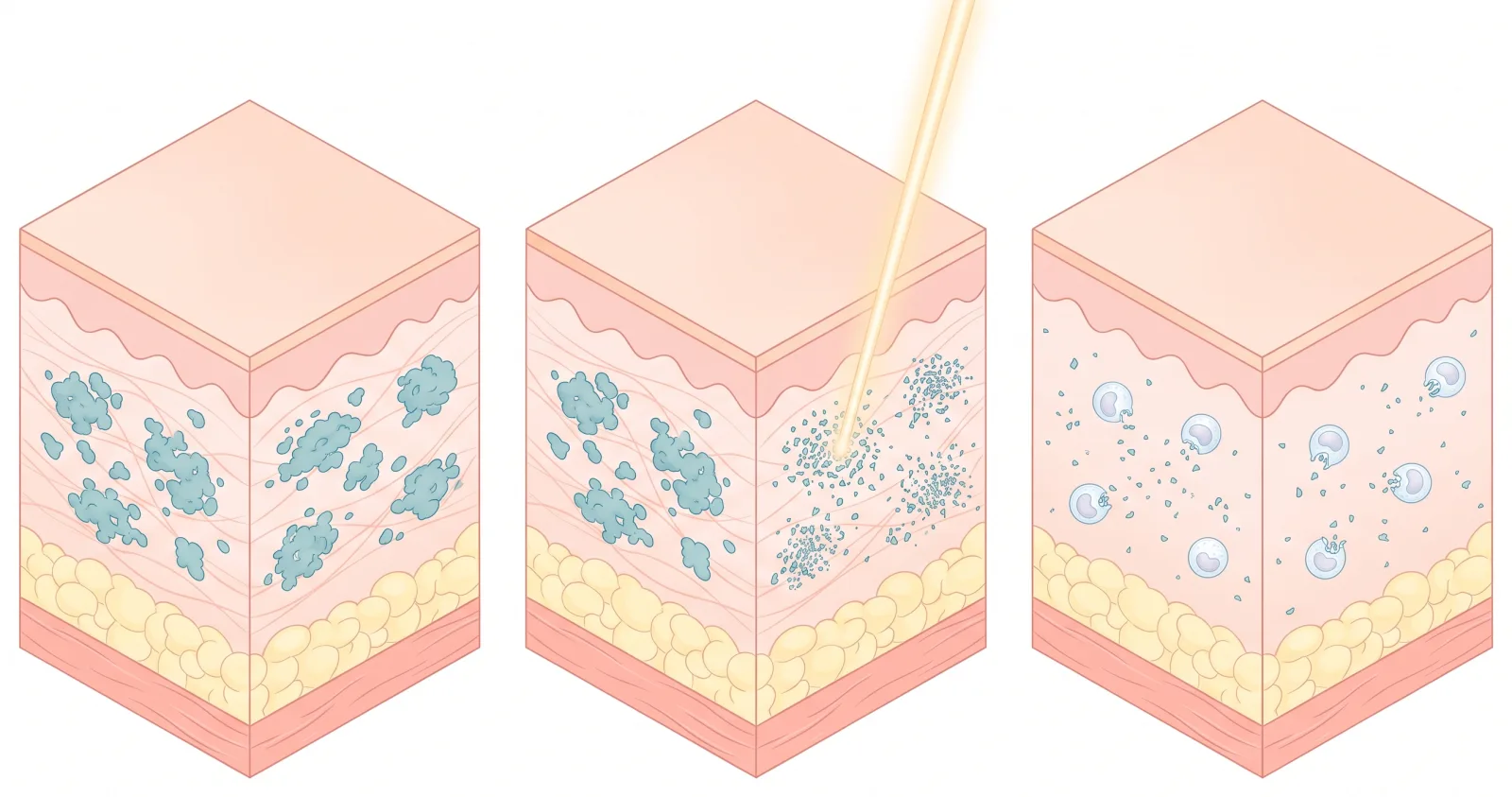
A tattoo is ink placed in the dermis, below the layer of skin that sheds. The pigment particles are too large for the body's cleanup cells to carry away, and that is what keeps the design in place for years. A laser pulse shatters those particles into smaller fragments that the lymphatic system can clear over the following weeks. How fast a tattoo fades depends on ink color, the amount of ink, its depth, its position on the body and the wearer's skin type, factors gathered in the Kirby–Desai scale (Egozi, 2024).
Some situations call for waiting first. Tanned, irritated or healing skin reacts more strongly to laser light, and a tattoo that has become itchy, raised or swollen needs a medical look before any removal begins.
Usually a good fit
- Black or dark blue tattoos you want faded
- Small designs up to about card size
- An old design to lighten before a cover-up
- Healed tattoos, professional or amateur
- Time for several visits at least 4 weeks apart
We may suggest waiting
- A fresh tan or sunburn over the tattoo
- Broken, infected or irritated skin on the design
- Pregnancy or breastfeeding
- A tattoo that is itchy, raised or swollen
- Keloid-prone skin (judged case by case)
- Recent isotretinoin or light-sensitizing medicine

Your doctor
Founder and medical director · Korean board-certified plastic surgeon
“From learning to teaching.”Trained at Seoul & Incheon St. Mary's Hospitals. Now leading hands-on sessions for visiting doctors.
- ResidentPlastic surgery, Catholic Univ. Seoul St. Mary's Hospital
- FellowClinical fellow, Incheon St. Mary's Hospital
- AlmaTitanium Global Trainer
- JeisysDENSITY ALPHA TIP Ambassador
- MemberKorean Society of Plastic and Reconstructive Surgeons
How it works
How a laser breaks down tattoo ink
Tattoo removal lasers deliver very short, high-energy pulses. Each pulse is brief enough that heat has little time to spread, so the energy stays mostly in the ink particle and shatters it. The body then removes the fragments bit by bit. Color therefore fades between visits, and each session is judged weeks after it took place.
Every ink color absorbs light differently, so the wavelength has to suit the color (Choudhary, 2010). Black absorbs a wide band of wavelengths and responds first. Red and orange answer to a different wavelength than green and blue. Yellow, white and pastel shades are harder to shift. A multicolor design fades unevenly, and one part of it can need more sessions than the rest.
Depth and density matter as well. Amateur tattoos can hold less ink at uneven depths, while professional work is denser and more even. Designs on the hands, feet and ankles, far from the heart, can take longer to clear. Layered tattoos and earlier cover-ups hold several sets of pigment stacked on top of each other.
Results build up slowly. A retrospective study of a Q-switched Nd:YAG laser found removal effective and safe, with fewer sessions needed than the Kirby–Desai scale predicted (Egozi, 2024). Reviews add that poor matching of wavelength, energy and pulse to skin type and ink raises the chance of side effects (Kurniadi, 2020). This page explains tattoo lasers in general terms, so ask which laser will be used when you request your quote.
Tattoo check
At consultationColors, size, location and the skin around the design are examined.
Numbing
Numbing cream is spread over the tattoo and left to take effect.
Laser pulses
The handpiece moves across the design and treated ink turns white for a short time.
Dressing
The area is cooled and covered, and wound care notes go home with you.
Next visit
4+ weeks laterFading is reviewed once the skin has healed, and the next pass is planned.
Laser options for marks on the skin at Pixelab Beauty Clinic
| Criteria | Tattoo removal | Age spot removal (MIIN) | CO2 mole removal |
|---|---|---|---|
| Target | Ink placed in the dermis | Flat brown spots from sun | Raised moles and milia |
| Method | Short pulses fragment ink | Light aimed at skin pigment | Tissue vaporized in thin layers |
| How it clears | Body removes fragments over weeks | Pigment sheds as skin renews | The lesion itself is taken off |
| Priced by | Card-sized area | Spot size, per 1 cm | Per mole or milium |
| From | ₩300,000 + VAT | See age spot prices | See mole removal prices |
Each option targets a different kind of mark; a spot that is changing or irregular is examined before any laser is used.
Session by session
| When | What to expect |
|---|---|
| Session 1 | The first pass shows how quickly each ink color reacts. |
| Following sessions | Spaced at least 4 weeks apart so fragments clear and the skin heals in between. |
| Later sessions | Stubborn colors get extra passes while faded areas are left alone. |
At a glance
Tattoo removal facts from the clinic
| Numbing | Numbing cream |
|---|---|
| Downtime | Redness, blisters and crusts possible for 1–2 weeks |
| Recommended sessions | Several sessions, at least 4 weeks apart |
| How long results last | Removal response differs by ink color |
| Earliest flight home | Same-day flight home is possible |
Prices
Tattoo Removal Cost in South Korea
The clinic's price list gives one figure for tattoo removal, for a design up to the size of a credit card. It is shown before VAT, and the card adds 10% VAT so you can see the amount payable at the desk.
Larger pieces, sleeves and multicolor work are not on the price list, because size and color change the work involved, so send clear photos of the design with its size when you ask for a quote. Removal runs over several sessions at least 4 weeks apart, so ask whether the quote covers one session or a set of visits, and budget for each trip to Seoul alongside it.
Tattoo removal
Up to card size₩300,000 + VAT₩330,000 with VATBook nowRecovery
Healing after a tattoo removal session
Ink whitens, then redness and swelling; same-day flight possible
Blisters may form; keep them intact and covered
Redness, blisters and crusts can last 1–2 weeks
Next session at least 4 weeks after this one
Safety
Tattoo removal risks and limits
Breaking up ink takes enough energy to injure the surrounding skin for a short time. The known effects are:
- Redness, swelling and pinpoint bleeding right after treatment.
- Blisters and crusts during the first one to two weeks.
- Lightening or darkening of the skin around the design, more likely in darker skin and with sun exposure.
- Texture change or scarring, especially if blisters are picked or the area becomes infected.
- Darkening of some inks: white, flesh-toned and certain red or brown pigments can turn gray or black after a pulse (Choudhary, 2010).
- Allergic reactions, as ink fragments are released into the body.
- Incomplete fading, with some colors still visible after several sessions.
A 2025 review of removal techniques lists these complications together with the safety steps used to lower them (Kassirer, 2025).
Contact the clinic if swelling spreads, pain worsens, yellow discharge appears or hives and itching develop away from the tattoo.
Evidence
Research behind this page
- Retrospective clinical evaluation of Q‐switched Nd: YAG laser safety and efficacy in tattoo removal: A new perspective on the Kirby–Desai scaleJournal of Cosmetic Dermatology · 2024 · Egozi E · doi:10.1111/jocd.16201
A retrospective study in which a Q-switched Nd:YAG laser removed tattoos safely and effectively, with fewer sessions than the Kirby–Desai scale predicted.
- Laser tattoo removal: Fundamental principles and practical approachDermatologic Therapy · 2020 · Kurniadi I et al. · doi:10.1111/dth.14418
A review explaining how skin type, ink color, wavelength, energy and pulse shape results, and how poor matching raises side effects.
- Lasers for tattoo removal: a reviewLasers in Medical Science · 2010 · Choudhary S et al. · doi:10.1007/s10103-010-0800-2
A review stressing that the laser must suit the ink color, and covering complications such as pigment change, allergy and ink darkening.
- Laser tattoo removal strategies: Part II: A review of the methods, techniques, and complications involved in tattoo removalJournal of the American Academy of Dermatology · 2025 · Kassirer S et al. · doi:10.1016/j.jaad.2024.05.097
A continuing-education review of removal methods, technique, safety considerations and complications of laser tattoo removal.
- Laser Tattoo Removal: A ReviewDermatologic Surgery · 2012 · Kent K · doi:10.1111/j.1524-4725.2011.02187.x
A review concluding that Q-switched lasers can remove many kinds of tattoos effectively and safely.
FAQ
Laser tattoo removal: questions before you travel
How many sessions does tattoo removal take?
Several. The clinic's guidance is multiple sessions with at least 4 weeks between them, and the total depends on ink color, density, depth and location. Black ink on the upper arm can fade sooner than a green or yellow design on the ankle.
Will my tattoo disappear fully?
We cannot promise full clearance. Dark inks can lighten a great deal over a course, while yellow, light green and white can leave a faint shadow. If you plan a cover-up, fewer sessions may be enough to lighten the old design for the artist.
What is the recovery after a tattoo removal session?
Redness, blisters and crusts can last 1 to 2 weeks. Dense ink, colors that need more energy and areas with thin skin can sit at the longer end. Keep blisters intact, cover the area and keep it out of the sun while it heals.
Can I fly home the same day after tattoo removal?
Yes, the clinic says a same-day flight home is possible. Keep the dressing clean during travel, and stay out of pools, saunas and hot springs until the crusts are gone. The next session comes at least 4 weeks later, which sets the spacing of your trips.
Does laser tattoo removal hurt?
Numbing cream is applied before the laser, yet each pulse can still feel like a sharp snap of heat. Areas over bone, such as the ankle, wrist or ribs, can feel stronger. The skin is cooled afterward to calm the heat.
What qualifications does the doctor have?
Dr. Jongkeun Song, the Medical Director of Pixelab Beauty Clinic, is a Korean board-certified plastic surgeon. Plastic surgery covers wound healing and scar care, relevant when laser work leaves blisters or crusts. Dr. Song is a member of the Korean Society of Plastic and Reconstructive Surgeons.
Is the tattoo removal price before VAT?
Yes. The card-sized price of ₩300,000 is listed before VAT, and ₩330,000 is the amount once 10% VAT is added at payment. Larger or multicolor tattoos are quoted separately, so ask what the quote includes.
Which tattoo colors are hardest to remove?
Yellow, light green, sky blue and white fade slowest because they absorb laser light poorly. Black and dark blue respond more readily. Flesh-toned, white and some red inks can darken after a pulse, so those areas are treated with extra care.
Can I ask about tattoo removal in English?
Yes. The clinic has an English interpreter on staff, and you can send a photo of your tattoo with its rough size on WhatsApp before you travel. We will get back to you as soon as possible.
What are the deposit and cancellation rules?
They are not published here. Before you pay anything, ask in writing for the deposit amount, refund conditions and how to move a date, since a removal course spreads over several visits at least 4 weeks apart.
Can I get a new tattoo over the old one after removal?
A cover-up can be planned once the skin has fully healed after your last session. Lightening the old design first gives the artist more freedom with color. Wait until no crusts, redness or tenderness remain, and show the area to your tattoo artist before booking.
Is scarring possible after laser tattoo removal?
Yes, it can happen. Texture change or scarring is a known risk, more likely when blisters are picked, the skin becomes infected or the tattoo already had raised areas. Gentle wound care and sun protection between sessions lower that risk.